
Board & Train in Terre Haute, IN
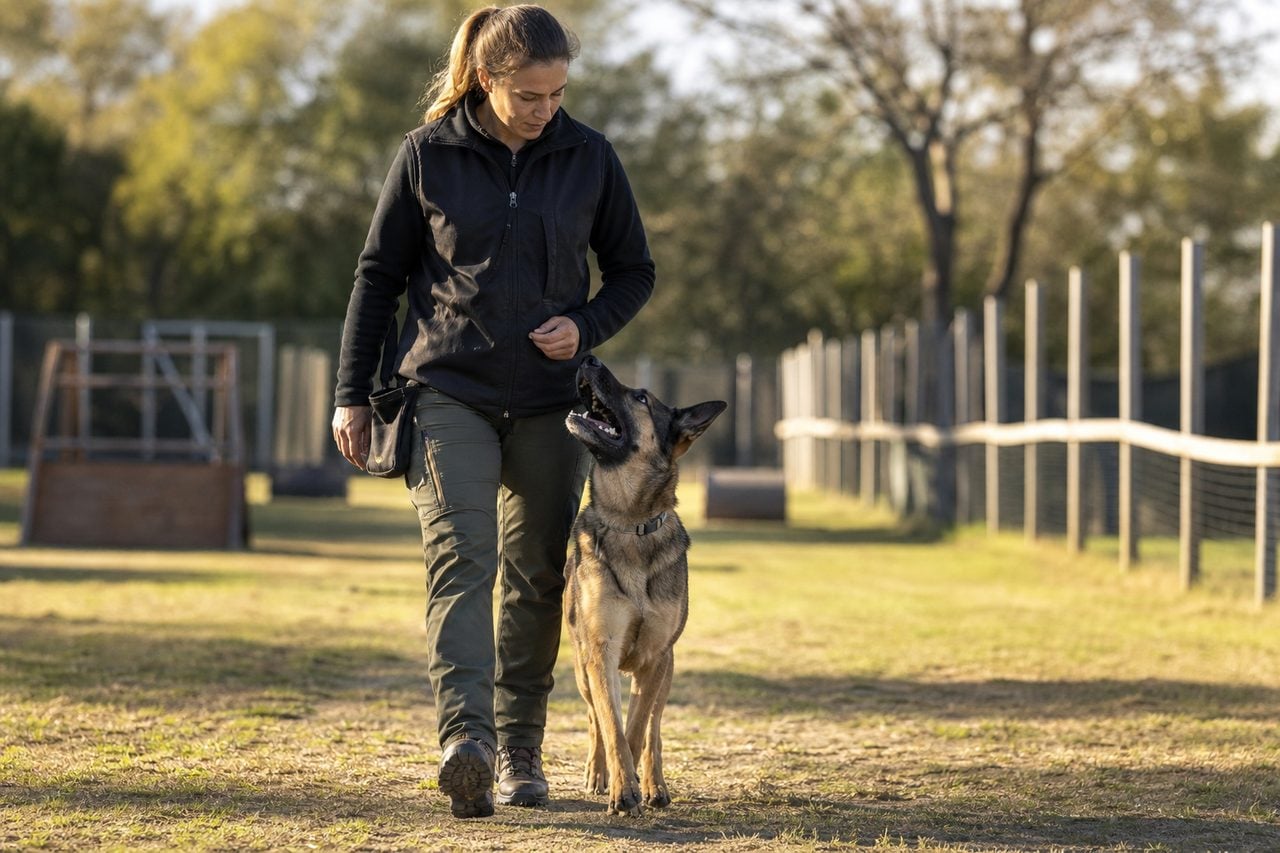
Board and train is the most intensive way to get a dog trained: instead of driving to a weekly class, your dog goes to live with a professional trainer for a set number of days and works every single day while there. In the Terre Haute area — the Vigo County seat on the east bank of the Wabash River, right up against the Illinois line — it is a format that appeals to households whose schedules simply will not bend around a six-week evening class. Between shift work at the plants, the academic calendars at Indiana State University downtown and Rose-Hulman Institute of Technology on the north side, and the ordinary chaos of family life, “drop the dog off and have a professional put the foundation in” is an attractive proposition.
- What Board and Train Actually Means
- Who Board and Train Suits — and Who It Does Not
- Board-and-Train Options in the Terre Haute Metro
- Facility Programs Versus In-Home Programs
- What It Costs and What Drives the Price
- The Handoff: Why Transfer Decides the Result
- How to Vet a Board-and-Train Program Before You Book
- Reviewed trainers
- FAQ
It is also the format most often oversold. A residency program buys you concentrated repetition and a trainer’s timing during the hardest, messiest stage of learning. It does not buy you a finished dog that behaves identically the moment it walks back through your front door. The handoff back to the owner is where board-and-train programs succeed or quietly fail, and the honest trainers in the Wabash Valley will tell you that before they take your deposit.
This guide covers what board and train actually is, who it suits, what genuinely exists in the Terre Haute metro versus what you would need to drive to Indianapolis for, and the specific questions to ask before you hand over your dog and your money.
What Board and Train Actually Means
In a board-and-train program, your dog boards with the trainer — at a commercial facility or in the trainer’s own home — for a defined stretch of days or weeks. During that stay the dog works multiple short sessions per day rather than one session per week. The compression is the entire point: a behavior that might take a family two months to build with a Tuesday-night class and inconsistent homework can be built in a fraction of that time when a professional is running five clean, well-timed reps a day in a controlled environment.
Programs generally fall into two shapes. Facility-based programs house dogs in a purpose-built kennel and training building, with structured work blocks, rest periods, and often exposure to other dogs and staff. In-home programs put the dog inside a trainer’s house, where it learns household manners in an actual household — doorbells, kitchens, couches, family traffic. Both are legitimate. They produce slightly different dogs, and the right pick depends on what you are actually trying to fix.
What you are paying for is not magic. It is three things: the trainer’s mechanical timing, which is better than yours and will be for a long time; frequency, which no working owner can match; and a controlled environment where the dog cannot rehearse the old behavior between sessions. That last one is underrated. A great deal of dog training is simply preventing practice of the thing you do not want, and a residency program does that around the clock.
What you are not paying for is a permanent behavioral install. Dogs learn in context. A dog that heels beautifully on the trainer’s property, on the trainer’s equipment, responding to the trainer’s voice, has learned exactly that. Turning it into a dog that heels for you, on the National Road Heritage Trail, in February, is a second job — and it is your job.
Who Board and Train Suits — and Who It Does Not
Board and train tends to be a genuinely good fit for a few specific situations. Households with no realistic weekly window — rotating shifts, long commutes east on I‑70, a new baby — get more from a residency program than from a class they will miss half of. Adolescent dogs between roughly seven and eighteen months, in the phase where a formerly biddable puppy has become a large, opinionated teenager, often respond dramatically to a few weeks of consistent structure. Dogs whose owners want reliable off-leash recall benefit from the sheer number of controlled repetitions a residency allows. And leash reactivity toward other dogs is frequently easier to work in a facility with a supply of neutral, well-behaved training dogs than it is on a sidewalk in your neighborhood.
It is a poor fit in other cases, and a trustworthy trainer will say so. Separation-related distress is the clearest example: the problem is the dog’s response to being apart from its people, and shipping the dog away from its people for two weeks does not address it and can make it worse. Very young puppies are another — the socialization window is about building positive associations with your life, your neighborhood, your visitors, and outsourcing that has real costs. Serious bite history with a meaningful liability profile deserves an in-person assessment and, in many cases, a veterinary behavior workup before anyone talks about a residency package.
The last poor fit is the most common one: the owner who wants to not be involved. If the plan is to collect a trained dog and change nothing about the household, the money is wasted. Every experienced board-and-train trainer has watched a dog they were proud of unravel in three weeks because nobody at home maintained the structure. Ask yourself honestly whether you will do the follow-through before you book.
Board-and-Train Options in the Terre Haute Metro
The honest picture is that the Terre Haute area has a short but real list. Two local providers genuinely run residency training, and they run it in two different formats.
K9.5 Training Academy, at 3475 Erie Canal Road, operates a purpose-built 10,000 square foot facility and runs a 12-day board-and-train program as well as a shorter 6-day program in which the owner attends and trains alongside the dog. The same site also offers boarding, day play, and grooming, which matters practically — a facility you already use for boarding is a facility your dog already knows. The owner, Larry Hopper, is the K9 Commander of the Vigo County Sheriff’s Office K9 Unit, a Master Trainer with DLE, and a former IPWDA trainer. That is a working-dog background, and it is worth understanding what that does and does not imply: it means deep experience with obedience, control, and handling under distraction, not that a pet dog will be run through police-dog work.
Top Dog Training LLC, owned by Nicole Thraen, runs the in-home version. Dogs live in the trainer’s home on an 8-acre property rather than in a kennel run, and board-and-train clients also get access to weekly group classes reserved exclusively for them — which is a sensible structure, because it builds the follow-up work into the package instead of leaving it to chance. One caution: the business’s website is no longer live, and it has previously paused taking new clients. Treat it as worth a phone call to check current intake rather than as a guaranteed open door, and do not build your plan around a spot you have not confirmed.
It is equally worth knowing what is not a board-and-train option locally. Unlimited Pawsibilities, on North Fruitridge Avenue, is the metro’s class and behavior-modification practice — it does not offer board and train. If a residency program is genuinely what you want and neither local option fits your timeline, the fuller range of formats, lengths, and specializations sits in Indianapolis, about an hour and fifteen minutes east on I‑70.
Facility Programs Versus In-Home Programs
The choice between a kennel-based program and a live-in-the-house program is not about which is kinder. Both can be excellent and both can be badly run. It is about the environment in which you want your dog to learn.
A facility program gives structure. The day is blocked: work, rest, work, decompression, work. Dogs learn to settle in a crate or run between sessions, which is itself a valuable skill for a dog that has never learned to switch off. The presence of other dogs and multiple handlers creates natural, controlled distraction — useful if the goal is a dog that can hold obedience while something interesting is happening. For dogs that are chaotic, over-aroused, or have never had a predictable routine, that clarity often does more good than anything specific taught in the sessions.
An in-home program teaches manners in the context where manners actually get used. The dog practises not counter-surfing next to a real counter, not bolting through a real door, settling on a real living-room floor while a television is on and people come and go. For household-manners goals — the dog that is fine in the yard and impossible indoors — that context transfer is a genuine advantage. The trade-off is capacity. An in-home trainer can only host a couple of dogs at a time, which is why intake windows are narrow and waiting is normal.
A practical way to decide: write down the three specific moments you want fixed. If they are “pulls on the leash,” “ignores recall at Fowler Park,” and “loses his mind when another dog appears,” a structured facility with distraction work is the better match. If they are “jumps on guests,” “steals food off the table,” and “cannot settle in the evening,” an in-home program is closer to the real problem.
What It Costs and What Drives the Price
There is no standard published rate for board and train, in Terre Haute or anywhere else, and you should be suspicious of any article that quotes one. What you can do is understand the cost drivers so that the number you are quoted makes sense.
Price is driven by length of stay, because you are paying for boarding and care as well as training. It is driven by staffing ratio — a program running two dogs at a time costs more per dog than one running twelve. It is driven by whether the quoted figure includes the transfer lessons, follow-up sessions, and any group classes afterward, or whether those are billed separately. Equipment is sometimes included and sometimes not. And the goal matters: foundation obedience, off-leash reliability, and behavior modification for reactivity or aggression are different amounts of work.
Ask for a written quote that itemizes what is included, what triggers an extra charge, what happens if the trainer recommends extending the stay, how veterinary care is handled and who authorizes it, and the refund or cancellation terms. Ask specifically how many follow-up sessions are in the package and how long you have to use them. A program that looks expensive per day but includes six months of follow-up support is frequently cheaper than a bargain package that hands the dog back at the gate and wishes you luck.
One more piece of financial hygiene: be wary of guarantees. Living animals do not come with guaranteed outcomes, and a trainer promising one is either overselling or has defined the guarantee so narrowly that it is meaningless. What a good program can promise is a defined process, honest interim reporting, and support afterward.
The Handoff: Why Transfer Decides the Result
Here is the part most owners underestimate. When the training is done, your dog has a working relationship with the trainer. It reads that person’s body language, knows their leash pressure, anticipates their timing, and understands the rules of that environment. You are a variable it has not practised with.
Transfer is a skill you have to be taught. Good programs build it in deliberately: sessions where you handle the dog with the trainer coaching, video of the cues and the mechanics so you are not relying on memory, written instructions for the first two weeks home, and a scheduled check-in. The 6-day format at K9.5 Training Academy, where the owner attends the program, is a structural answer to this problem — the transfer happens continuously rather than in one rushed hour at pickup. The weekly group classes that Top Dog Training reserves for its board-and-train clients serve the same purpose from the other direction, giving owners a recurring place to keep practising with supervision.
Whatever the format, plan the first fortnight home carefully. Keep the structure the trainer used — same crate routine, same feeding pattern, same rules about furniture and doorways — before you start relaxing anything. Practise in boring places first: your own hallway, your own yard, an empty corner of Deming Park early in the morning. Then add difficulty in deliberate steps: the Dobbs Park & Nature Center trails, a busier stretch of the National Road Heritage Trail, Hawthorn Park on a weekend. Each new environment is a small re-teach, not a test the dog should already pass.
Expect some regression. It is normal, it is not evidence the program failed, and it usually resolves within a couple of weeks if you hold the line rather than renegotiating the rules. The dogs that lose their training are almost always the ones whose households quietly went back to the old arrangements.
How to Vet a Board-and-Train Program Before You Book
You are leaving a family member in someone else’s care, unsupervised, for days or weeks. That deserves more scrutiny than most people apply. Tour the place in person before you commit, and be direct about what you want to see.
- See where the dogs actually sleep. Not a photo — the runs, the crates, the rest area. Look at cleanliness, ventilation, temperature, and noise levels.
- Ask who is on site overnight and what the protocol is if a dog gets sick at two in the morning. Ask which veterinary practice they use and who authorizes treatment.
- Ask them to describe their methods in plain language, including every tool they might use on your dog and under what circumstances. If the answer is vague, evasive, or leans on jargon, that is your answer.
- Ask what happens if your dog is not a good fit for the program — if it shuts down, will not eat, or escalates. A professional has a plan for this and will tell you.
- Ask for updates in writing and on video during the stay, and confirm the frequency up front.
- Read the contract before you sign it, particularly the sections on liability, extensions, refunds, and what happens if the dog injures another dog or a staff member.
Two credentials-related notes. Dog training is not a licensed profession in Indiana, so anyone may use the title “trainer.” Certifications and working-dog backgrounds are meaningful signals but are not interchangeable with a fit for your specific dog — a superb police-K9 handler and a superb family-pet trainer are overlapping but distinct skill sets, and the right question is always “how much work have you done with dogs like mine, with goals like mine?”
Finally, if a trainer tells you that your dog is not a candidate for board and train, take it seriously rather than shopping until someone says yes. That kind of honesty is the strongest positive signal in the whole industry, and in a metro this size it is worth more than any marketing.
Board & Train in Terre Haute: Local Options & Nearest Specialists
Local Terre Haute-area options for board & train:
- K9.5 Training Academy — 4.9★ (73 reviews)
- Top Dog Training LLC — 4.9★ (27 reviews)
Nearest board & train specialists — Indianapolis
For complex cases, some families travel to the larger pool of specialists in the Indianapolis area for an assessment or a board-and-train stay. Top-reviewed options:
- Nate Schoemer Dog Training — 5.0★ (188 reviews)
- Good Bones K9 Training — 5.0★ (31 reviews)
- Steven’s Bootcamp Dog Training Indianapolis — 5.0★ (9 reviews)
- Lead & Learn Canine Solutions — 5.0★ (7 reviews)
- Paws a Moment Dog Training LLC — 5.0★ (1 review)
- Indy K-9 — 4.9★ (123 reviews)
- Big N’ Small Paws 317 — 4.9★ (97 reviews)
- Kingdom Bully Kennels — 4.9★ (58 reviews)
See all Indianapolis board & train trainers →
Frequently Asked Questions
How long does a board-and-train program usually last?
It varies by goal and by trainer. Locally, K9.5 Training Academy runs a 12-day board-and-train and a shorter 6-day program in which the owner attends and trains alongside the dog. Shorter stays generally target foundation obedience and specific manners; longer stays are used for off-leash reliability or behavior modification. Ask any trainer to tie the length directly to your written goals rather than picking a package off a price list.
Are there board-and-train options in Terre Haute itself?
Yes, two genuine local options. K9.5 Training Academy on Erie Canal Road runs facility-based programs in a 10,000 square foot purpose-built building, and Top Dog Training LLC runs an in-home board-and-train on an 8-acre property where dogs live in the trainer’s house. Note that Top Dog’s website is no longer live and it has previously paused new-client intake, so call to confirm current availability. Unlimited Pawsibilities, the area’s class and behavior practice, does not offer board and train. Indianapolis, about an hour and fifteen minutes east on I‑70, has a much wider range of residency formats.
Will my dog forget everything when it comes home?
Not forget, but it will not automatically perform for you the way it performed for the trainer. Dogs learn in context, and you are a new context. That is why transfer lessons, written homework, and follow-up sessions matter more than the program length. Expect a dip in the first week or two at home; it usually resolves if you keep the trainer’s structure in place instead of relaxing the rules early.
Is board and train appropriate for separation anxiety?
Generally no. Separation-related distress is a response to being apart from the dog’s attachment figures, and removing the dog from those people for a residency stay does not address the underlying problem and may intensify it. That situation calls for a behavior professional working with you at home, and often a veterinary assessment to consider whether medication should be part of the plan. Terre Haute has behavior-modification help locally; a board-certified veterinary behaviorist would require travelling to Indianapolis or to Purdue’s veterinary behavior service in West Lafayette.
What should a board-and-train quote include?
An itemized written quote should state the length of stay, what training goals are covered, how many transfer and follow-up sessions are included and for how long, whether equipment is included, how additional charges are triggered, the veterinary-care and emergency policy, and the cancellation and refund terms. Be cautious of any program offering a guaranteed behavioral outcome; living animals do not work that way, and a defined process with honest reporting is a far better sign.
What can I do instead if board and train is not the right fit?
Day training, where the dog trains with a professional during the day and comes home at night, keeps the dog in your household while still getting expert repetitions. Private in-home lessons put the training exactly where the problems occur. Group classes build skills under real distraction and are excellent for social dogs and for maintenance after any intensive program. For behavior cases involving fear, anxiety, reactivity, or aggression, a behavior-focused practice is usually the better starting point than a residency package.
Related: read our complete board & train guide or the full Terre Haute dog training overview.
Ready to find the right board & train pro in Terre Haute?